The Wisconsin Literacy Research Symposium is an annual summer event that provides professors, students, and professional educators with peer-reviewed research to support literacy practices in K-12, and higher education settings. The symposium has been hosted by Wisconsin public and private universities across the state for decades. This summer it is being hosted by the University of Wisconsin Oshkosh in conjunction with UW Stout and UW Eau Claire.
The 2026 Wisconsin Literacy Research Symposium, Writing Instruction in a Changing Landscape brings together three research presentations that explore the evolving nature of writing teaching and learning. Topics include the role of artificial intelligence in writing instruction and multilingual early childhood writing and translingual practices. Together, these sessions invite educators and researchers to consider how writing instruction can remain responsive, inclusive, and meaningful amid changing technologies, languages, and literacy demands.
Speakers
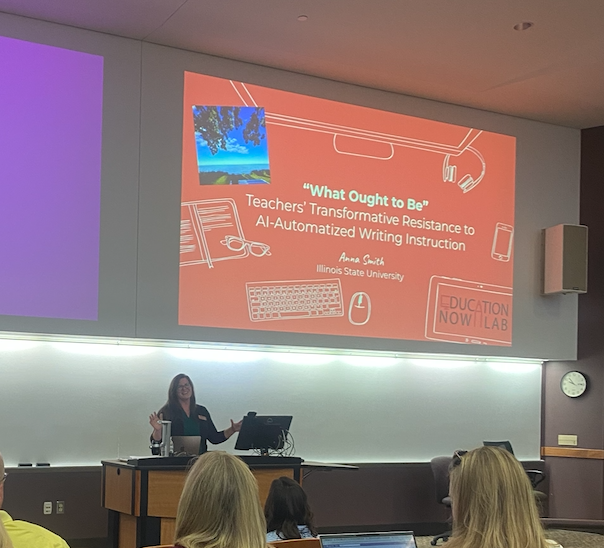
Anna Smith, Ph.D.
Title: “What Ought to Be”: Teachers’ Transformative Resistance to AI-Automatized Writing Instruction
Description: As schools rapidly adopt generative AI products, writing instruction risks becoming more scripted, standardized, and dehumanized. In this session, I share findings from teachers' critical platform walkthroughs that trace how teachers question, tweak, and subvert AI lesson outputs to protect writing instruction as relational, inclusive, and developmentally responsive. We'll discuss critical junctures in deciding how to use emerging technologies in our teaching to support our advocacy for what we believe "ought to be" in writing instruction today.
Bio: Anna Smith (PhD, NYU) is the 2025-2026 Provost Fellow, Associate Professor, and founding member of the Education Now Lab at Illinois State University. Her research examines literacies and emerging technologies—with a special focus on how teachers navigate the ethical terrain of generative AI for writing instruction, equity, and humanizing pedagogy. Smith is co-author of Developing Writers: Teaching and Learning in the Digital Age and co-editor of the Handbook of Writing, Literacies, and Education in Digital Cultures. She also serves as a lead co-editor of the Literacy Research Association journal Literacy Research: Theory, Method, and Practice.
Emily Machado, Ph.D.
Session Title: The Power of Critical Translingual Writing in Early Childhood
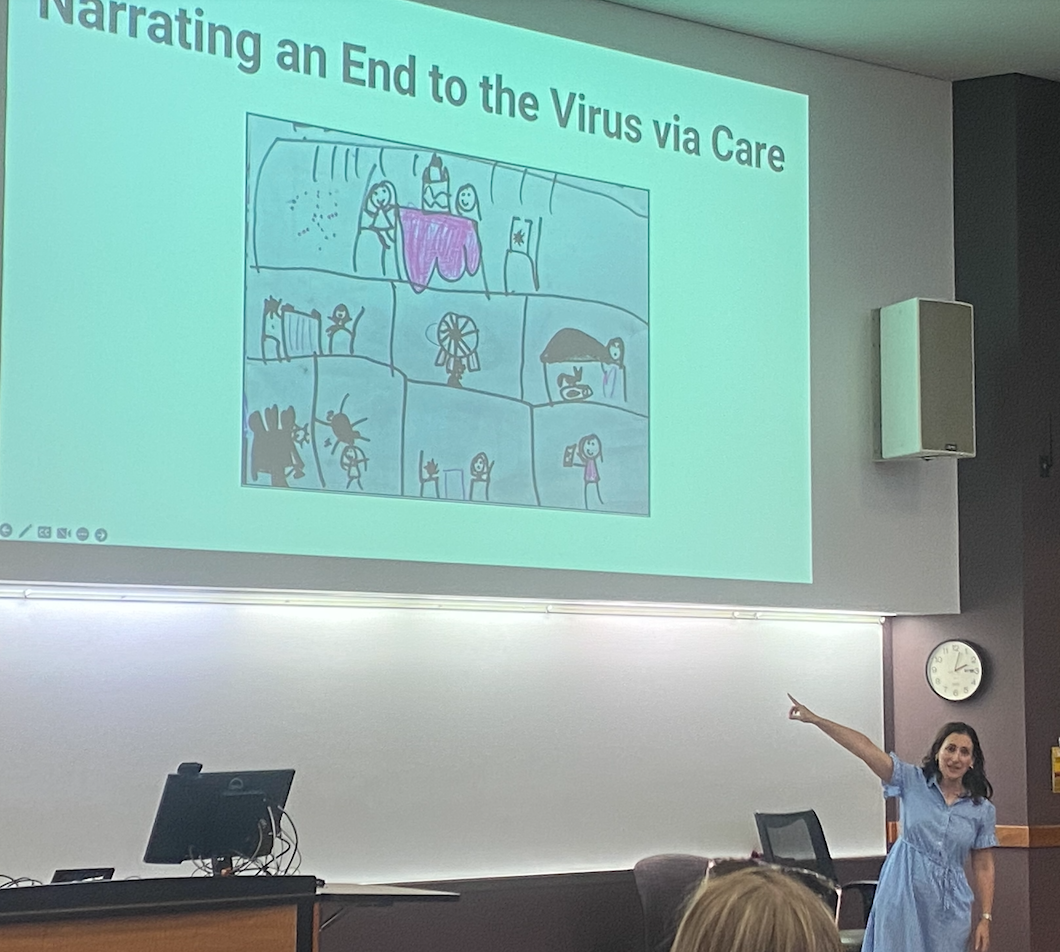
Description: Although writing has long been explored as a vehicle for changemaking, young children—and particularly those who are multilingual— are rarely offered opportunities to write in ways that reshape their worlds. Drawing on findings from two qualitative studies of young multilingual writers, this session explores the power of critical translingual writing pedagogies in supporting such work. In one project, multilingual second graders composed and shared translingual poetry about their names in ways that reshaped their classroom's power dynamics. In another, young children in a virtual art/writing workshop composed playful stories that took action on the COVID-19 pandemic and intersecting crises. Together, these projects highlight the power and potential of translingual writing to reshape and reimagine the world, including for the youngest writers among us.
Bio: Emily Machado is an associate professor of early childhood education at the University of Wisconsin-Madison, where she also serves as Director of the Elementary Teacher Education Program. She is a former public school teacher who taught kindergarteners through third graders in Washington DC in both general education and English as a New Language settings. Her research is focused on the teaching and learning of literacy in multilingual early childhood classrooms, and her scholarship and teaching have been recognized with honors such as the Literacy Research Association’s Early Career Achievement Award and UW-Madison’s Chancellor’s Inclusive Excellence in Teaching Award. She holds a BS in Education and Social Policy from Northwestern University, an MAT in ESOL from American University, and a PhD in Curriculum and Instruction from the University of Illinois at Chicago.
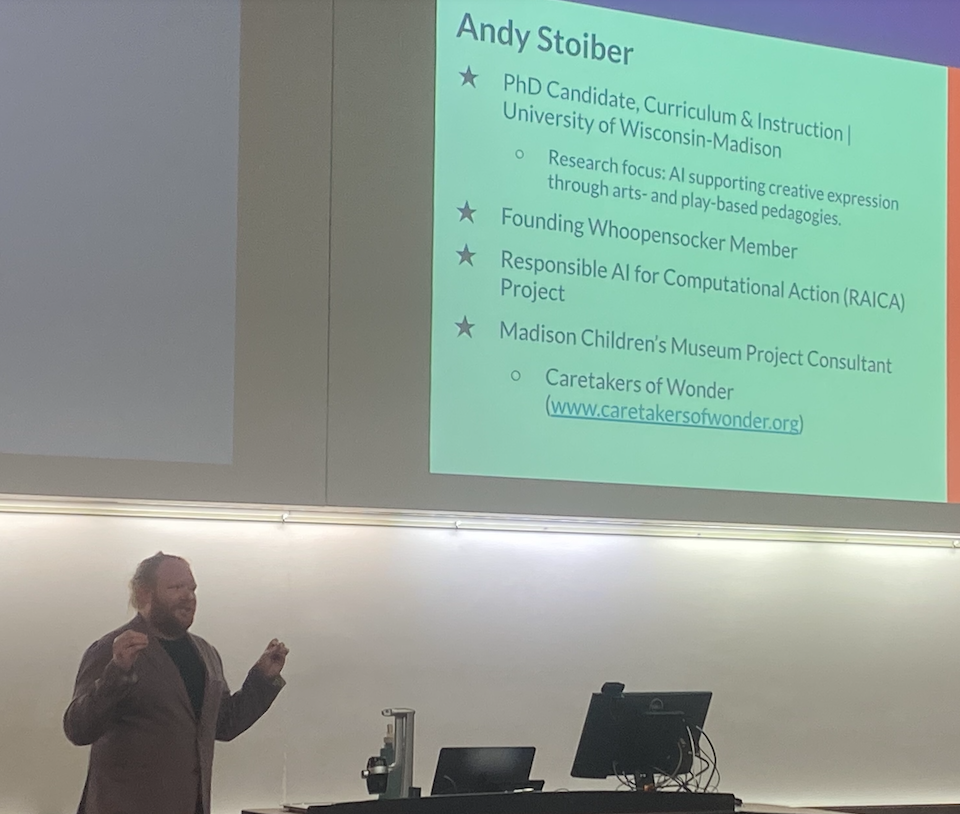
Andy Stoiber
Session Title: Scaffolding creative writing with Whoopenbot: Designing asset-based AI to support writers rather than replace them
Description: This research-grounded session seeks to disrupt the polarizing and ongoing discourse surrounding AI by investigating a practical promise the technology portends: how do we design generative AI that strengthens learners' own writing and creative voice? Drawing on dissertation research and years of ethical AI curriculum design, the presentation situates AI as a sociotechnical system, traces its place in the long history of writing technologies, and surfaces the ethical tensions most relevant to writing instruction. It then introduces the principles of asset-based AI design — tools built to help writers generate and develop their own ideas rather than supply t Title: Scaffolding creative writing with Whoopenbot: Designing asset-based AI to support writers rather than replace them
Bio: Andy Stoiber is a PhD candidate in the Department of Curriculum & Instruction at UW-Madison. Andy researches and designs playful, art-based, and AI-infused learning environments, assessments, tools, and curriculum which center learners’ interests and assets as a foundation to build their literacies as readers and writers, their confidence and agency as creators, and their technological fluency with AI–to equip them with the tools and knowledge to navigate and flourish in the 21st century.
Schedule
9:00-9:20 Registration
9:20-9:30 Opening
9:30-11:00 Dr. Anna Smith
11:00-12:00 Lunch Provided
12:00-1:00 Andy Stroiber
1:00-1:15 Break
1:15-2:15 Dr. Emily Machado
2:15-2:30 Closing
2025 Wisconsin Literacy Research Symposium
The 2025 Literacy Research Symposium, Shifting the Power: Humanizing Literacy Policy and Practice was held at the University of Wisconsin, Eau Claire in June. It was a very informative day with Dr. Michael Young of Illinois State University, Normal, Dr. Crystal Wise of the University of Minnesota, Twin Cities, and Dr. Elena Aydarova of the University of Wisconsin, Madison presenting their research.
 |
 |
 |
| Dr. Michael Young |
Dr. Crystal Wise |
Dr. Elena Aydarova |